
Why “which CDU should I buy” is the wrong first question for an AI deployment — and what the right one looks like.
I’ve spent a lot of time over the last year inside conversations about liquid cooling. Customer side, vendor side, integrator side. And I’ve noticed something: nearly every one of those conversations starts with the wrong question.
The wrong question is “which cooling vendor do I pick?”
The right question is “who is going to actually deploy this thing, and do they care which vendor I pick?”
Those are not the same question. And the gap between them is where most AI infrastructure projects go sideways.
The market in 2026
If you’re standing up high-density compute right now, your shortlist almost certainly includes some combination of these names:
Vertiv has spent the last 18 months turning itself into an end-to-end power-and-thermal vendor. The CoolChip CDU family, the CoolPhase Flex, the MegaMod HDX prefab pods, plus the recent acquisitions of Strategic Thermal Labs (cold-plate engineering) and PurgeRite (fluid services) mean they can sell you almost everything from chip to chiller. Their pitch is integration: one vendor, one support number, one throat to choke.
Motivair, now owned by Schneider Electric, brings the most credentialed CDU portfolio in the industry. Their MCDU-70 hits 2.5 MW per unit, scales centrally past 10 MW with EcoStruxure, and Motivair technology already cools six of the world’s top ten supercomputers. If you’re standing inside a Schneider power and BMS ecosystem, they fit like a glove.
Boyd is the volume play. Five million liquid cold plates shipped to hyperscalers. NVIDIA RVL-listed for cold plates, manifolds, and CDUs. The ROL4000 is a 2 MW in-row CDU built around the OCP Project Deschutes Gen5 spec. Boyd is what shows up when somebody decides their AI factory needs to look like the ones Meta and Microsoft are building.
Dell’s IR7000 isn’t a cooling vendor — it’s an OEM rack. But it’s now showing up in cooling conversations because it bundles native direct liquid cooling into a 21-inch ORv3 rack that supports up to 480 kW per rack and captures roughly 100% of the heat. Combined with Dell’s IRSS program (factory L11/L12 integration), you can have a fully populated GB200 NVL72 rack delivered, networked, and tested as a single SKU.
Accelsius NeuCool is the wildcard. Two-phase, dielectric-refrigerant, direct-to-chip cooling — technology originally developed at Bell Labs. Their MR250 row CDU delivers 250 kW per rack, the new IR150 puts 150 kW into a single 800mm integrated rack, and they’ve publicly tested cooling chips beyond 1,500 watts. The dielectric coolant means a leak doesn’t kill your IT. Their facility-water tolerance up to 45°C means more free-cooling days. It’s a different physics approach, and for the right deployment it’s genuinely better.
Five very different products. Five very different buying motions.
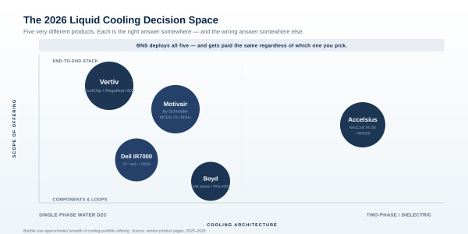
And here’s the thing nobody likes to say out loud: each of them is the right answer somewhere, and each of them is the wrong answer somewhere.
What the vendors won’t tell you
Every one of those companies will be happy to sell you their stack. None of them will tell you when their stack is the wrong fit.
That’s not a knock on them. It’s just what vendors do. But if you’re a colocation operator, a neocloud, an enterprise standing up your first GPU cluster, or a federal program office trying to deploy AI under CMMC, the answer to “which cooling do I pick” is almost never the same as “which cooling does this vendor sell.”
The honest version of the trade-offs:
• A Vertiv MegaMod HDX prefab pod compresses your schedule beautifully, but you commit to a footprint and a vendor ecosystem early. If your real constraint is speed-to-power, that’s a great trade. If your real constraint is flexibility for whatever GPU comes out in 2027, it’s not.
• A Motivair MCDU-70 at 2.5 MW is the right answer for an NVIDIA-certified hyperscale build inside a Schneider-anchored facility. It’s overkill — and locks you into a specific controls ecosystem — for a 4-rack pilot.
• A Boyd ROL4000 plus their cold-plate-and-manifold stack is what hyperscalers buy. It’s component-and-loop strength. If you need somebody to also handle your facility chilled water plant and BMS integration, that’s not really their lane.
• The Dell IR7000 with IRSS gives you a rack-scale AI factory unit that arrives plug-and-play. But it’s a 21-inch ORv3 rack — not a drop-in for your existing 19-inch white space. And the facility loop, the CDU, and the heat rejection are still on you.
• Accelsius two-phase mitigates leak risk and unlocks free cooling in climates where single-phase water cooling would force you onto chillers. But the install base is newer, and the refrigerant handling means your deployment crew needs EPA 608 certification — not optional, federal law.
The right answer depends on your facility, your existing vendor relationships, your GPU roadmap, your budget, your risk tolerance, and a dozen other things that the cooling vendor’s account manager doesn’t have visibility into.
| The cooling vendor isn’t the one putting the cooling in the building. |
The deployment problem nobody scoped
Here’s the thing that gets missed in almost every one of these conversations: the cooling vendor isn’t the one putting the cooling in the building.
A CDU lands on your dock. Somebody has to set it, level it, anchor it, and isolate it from vibration. Somebody has to run the manifolds, terminate the quick-disconnects, pressure-test the loop, fill it with the right coolant or refrigerant, leak-check it, and tie it into the heat rejection — whether that’s a dry cooler, a rear-door heat exchanger, a building chilled water loop, or all three. Somebody has to bring MV/LV power to the rack, terminate the busway or PDU whips, and pull the structured cabling. Somebody has to integrate the controls into your DCIM or BMS. And then somebody has to commission the whole thing and hand you documentation.
Most cooling vendors will sell you “deployment services.” What that often means in practice is: their factory rep shows up for a couple of days during commissioning, and the rest gets handed off to whatever subcontractor your GC scrounged up.
That’s the gap. And it’s the gap where schedules slip, where leak events happen, where the wrong glycol mix gets used, where the busway lands two inches off the manifold, where the cabling violates the airflow plan. It’s not the cooling vendor’s fault. They sold you cooling. The deployment is somebody else’s problem.
What “vendor-agnostic deployment partner” actually means
At BNS, we don’t OEM cooling hardware. We don’t white-label CDUs. We don’t take spiff dollars from any of the vendors above. We’re not trying to talk you into Vertiv, or Motivair, or Boyd, or Dell, or Accelsius.
What we do is the work that turns a cooling spec into a working rack, and we do it the same way regardless of whose logo is on the equipment:
• Site survey, BIM staging, and MEP coordination before anybody breaks ground
• A reference-design review where we’ll tell you when the BOM is wrong, even if it’s expensive to be right
• MV/LV electrical to the rack — busway, PDU, whip terminations, all of it
• CDU and manifold install, fluid fills and flushes, pressure decay and leak testing
• EPA 608-certified refrigerant handling for two-phase systems
• Heat rejection tie-in, whatever the architecture
• Structured cabling, fiber, and DCIM/BMS integration
• Commissioning, IST support, as-builts, and lifecycle service
Trade-stacked under one project manager. Not three subs handing off to each other across a six-month schedule.
The right first question
So go back to the top.
If you’re picking cooling for an AI deployment, the right first question isn’t “Vertiv or Motivair” or “single-phase or two-phase” or “IR7000 or build-it-yourself.” Those are all good questions. They’re just not first.
The right first question is: who’s going to deploy this for me, and are they going to tell me the truth about which vendor to pick?
If the answer is “the cooling vendor’s preferred integrator,” you already know what answer you’re going to get.
If the answer is somebody who deploys all of them — and gets paid the same regardless of which one you choose — you’re going to get a different conversation. A more useful one.
That’s the conversation we want to have.
• • •
Jon Billow is Chief Revenue Officer at BNS, a veteran-owned services company specializing in network and power infrastructure deployment for data center, carrier, and federal customers. BNS is vendor-neutral on cooling hardware and deploys liquid cooling systems from every major OEM in the market.